
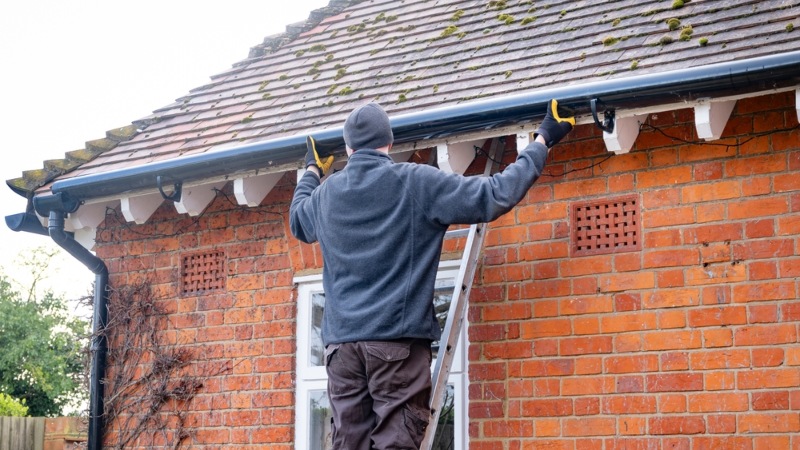
In the fall of 2021, a homeowner in Preston Hollow noticed a small stain creeping down her dining room wall. She assumed it was a roof issue. She called a roofer. He found nothing wrong. By spring, the stain had spread, her fascia boards were rotting through, and a structural engineer was standing in her backyard explaining that the soil beneath her slab had shifted nearly an inch. The culprit? A single clogged, overflowing gutter that had been silently dumping concentrated roof runoff against her foundation for two full years. The repair bill landed at just under $14,000. Her gutters, meanwhile, had needed a $390 fix. Stories like this play out across North Texas every storm season, which is why working with a trusted gutter company dallas isn’t a luxury — it’s the cheapest insurance a homeowner can buy.
This isn’t a rare edge case. Dallas sits on some of the most reactive clay soil in the country. The stuff swells when wet and contracts when dry, and according to the Texas A&M AgriLife Extension Service, expansive clay soils affect more than 33% of Texas land area — with the DFW Metroplex sitting squarely in one of the highest-risk zones. Add spring storm seasons that can dump several inches of rain in a single afternoon, cedar elm and live oak trees that shed debris across multiple seasons, and summer heat that pushes gutter seams to their limits — and you have the perfect conditions for gutter failure to spiral into structural catastrophe.
The Damage Chain Nobody Talks About
Here’s what actually happens when gutters stop working — step by step, damage by damage.
It starts with debris. Leaves, seed pods, shingle grit, and storm sediment build up inside the gutter channel. Water backs up. Instead of flowing toward the downspout and away from the house, it sits. It overflows. It runs behind the fascia board — the strip of wood trim that holds the gutter in place. That wood absorbs moisture, softens, and starts to rot. Most homeowners never see this happening because it’s tucked up under the roofline.
While the fascia deteriorates, water is also dripping down the siding and pooling at the base of the house. On a Dallas-area property, that pooling water is absorbed by the clay soil directly against the foundation. The University of Texas at Austin’s Bureau of Economic Geology has documented for decades how moisture fluctuations in expansive clay soils cause differential foundation movement — meaning one side of a slab rises or sinks independently of another. That’s when doors stop closing. Floors crack. Drywall gaps open at the corners.
Foundation repair in North Texas typically runs between $3,500 and $15,000 depending on severity, according to HomeAdvisor’s national cost database. Pier and beam leveling, underpinning, and slab stabilization are not small projects. They are disruptive, expensive, and — in a large percentage of cases — entirely preventable with functional gutter and drainage systems.
The damage chain looks like this: clogged gutters ($0 problem initially) become fascia rot ($800–$2,500 repair) become moisture intrusion ($1,500–$5,000) become foundation movement ($3,500–$15,000). Every step multiplied the cost. Every step was preventable at the previous one.
What Dallas Weather Does to Gutters That Most Guides Won’t Tell You
North Texas weather is genuinely brutal on exterior home systems. It doesn’t get enough credit for that.
Spring brings fast, heavy storms. The National Weather Service records for Dallas show that the metro regularly experiences rainfall events exceeding two inches per hour during peak storm season — March through May. Standard 5-inch gutters struggle to handle those flow rates without proper downspout placement and pitch. Undersized or improperly installed systems overflow not because they’re clogged, but because they were never designed for what Texas throws at them.
Then there’s the debris problem. Preston Hollow, North Dallas, and neighborhoods throughout Richardson and Plano are lined with live oaks, cedar elms, and pecan trees. Cedar elms in particular are notorious for a prolonged shedding cycle — they drop leaves, then catkins, then seeds across nearly three seasons. Most gutter cleaning guides suggest twice-yearly cleaning. In heavily treed DFW neighborhoods, twice a year isn’t enough. Three cleanings — after spring flowering, after fall leaf drop, and a mid-summer check — are closer to the real standard.
Summer adds its own stress. Aluminum gutters expand and contract with temperature swings. Dallas summers routinely push past 100°F for weeks at a time. Gutter seams that weren’t sealed properly will eventually pull apart under that thermal cycling. A leaking seam is a minor repair when caught early — typically $75 to $200 to reseal. Left alone through another Texas summer, that same seam becomes a fascia replacement job.
And none of this accounts for hail. DFW sits inside what meteorologists call “Hail Alley.” Hailstorms routinely dent aluminum gutters, knock hangers loose, and create misalignment that disrupts water flow. Many homeowners file roof insurance claims after a hailstorm and never think to have the gutters inspected. The gutters absorbed impact too.
The Full Picture of Gutter Services — And Why Piecemeal Fixes Fail
One of the most common mistakes Dallas homeowners make is treating gutter problems as isolated incidents. A single section sags — they rehang it. A seam leaks — they caulk it. A downspout clogs — they flush it out with a garden hose.
This approach isn’t wrong exactly. But it misses the system-level view that separates a functional gutter system from a collection of individual parts that sort of work.
A complete gutter and drainage system does several things simultaneously. It captures roof runoff at the fascia line. It channels water at the correct pitch — typically a quarter inch of slope for every ten feet of horizontal run — toward downspouts. Those downspouts carry water down and away from the foundation. Extensions or drainage systems then move that water far enough from the house that it doesn’t saturate the soil at the footing.
Fail at any one of these handoffs and the whole system breaks down. A gutter with perfect pitch but an undersized downspout still overflows. A downspout that drains directly against the foundation is almost worse than no downspout at all. Drainage solutions — French drains, channel drains, downspout extensions, and underground drain lines — are the final leg of the system that most homeowners never install.
This is where full-service gutter providers earn their value over single-trade handymen. The ability to evaluate and address the entire water management chain — from roof edge to property drainage — is what actually protects a foundation long term. Gutter installation, gutter cleaning, gutter repair, gutter guard installation, and drainage solutions aren’t five separate services. They’re five components of one system.
Seamless Gutters vs. Sectional — Why It Matters in Texas
Sectional gutters are the pre-cut systems sold at big-box stores and snapped together on-site. They’re cheaper upfront. They’re also full of joints — and every joint is a potential failure point. In North Texas’s thermal cycling environment, those joints expand and contract constantly. They crack seals. They separate. They drip.
Seamless aluminum gutters are fabricated on-site using a rolling machine that extrudes a continuous run of aluminum to the exact length of each section of roofline. No joints in the middle of a run — only at corners and downspout connections. Far fewer leak points. Better performance in high-heat environments. Most Dallas gutter professionals recommend seamless aluminum as the default for new installation and full replacement jobs.
New seamless aluminum gutter installation typically runs $6 to $14 per linear foot installed across the DFW market. A typical 2,000-square-foot home with around 160 to 180 linear feet of guttering comes out to roughly $1,000 to $2,500 all-in, including downspouts and haul-away of the old system. That cost range moves with roof height, pitch complexity, and the number of downspouts needed.
Gutter Guards — Do They Actually Work?
Short answer: quality guards installed correctly do work. They block leaves, seed pods, and debris from entering the gutter channel while allowing water to flow through. They don’t make gutters maintenance-free — a seasonal visual check is still smart — but they eliminate the repeated ladder climbs and emergency cleanouts that drive up annual maintenance costs.
For homes under heavy tree canopy in neighborhoods like Lakewood, University Park, or North Dallas, gutter guards can reduce cleaning frequency from three times per year to once, and they pay for themselves quickly in avoided service calls. The caveat is installation quality. Guards improperly seated can actually direct water over the gutter edge or trap debris in ways that make cleaning harder. Professional installation matters here as much as product selection.
The Inspection Problem — And the Fix
Here’s a pattern worth noting: most gutter service calls in Dallas are reactive. Something breaks, fails visibly, or causes obvious water damage — then the homeowner calls. By that point, the minor issue has usually already cascaded into something more expensive.
The FEMA National Flood Insurance Program’s data on residential water damage consistently shows that early detection and preventive maintenance reduce claims severity significantly. The principle applies directly to gutter systems. A misaligned downspout identified during a routine inspection costs almost nothing to correct. That same misalignment discovered after two years of foundation moisture loading costs thousands.
A thorough professional inspection of a gutter system covers more than most homeowners realize. Structural integrity of the gutter channel itself. Pitch and slope across each run. Seam and joint condition. Hanger spacing and fastener security. Downspout connection points. Fascia and soffit condition beneath the gutter. Drainage outlet assessment at grade. Evidence of prior overflow or water staining on siding and foundation areas. That’s the kind of systematic check that catches the slow-developing failures — the ones that end up costing the most.
Emerson Gutters and Drainage includes a free 25-point inspection with every service visit. Every item in that inspection is evaluated and communicated to the homeowner before any work is recommended. There are no verbal promises or guesswork. Findings are clear. Recommendations are specific. And a written estimate is provided before any work begins.
That last point — the written estimate — matters more than it might seem in a market where storm-chaser contractors show up after hailstorms and pressure homeowners into verbal agreements on the spot. A written estimate is both a consumer protection tool and a credibility signal. A contractor who won’t provide one in writing before starting isn’t a contractor worth hiring.
Repair vs. Replacement — The Decision Most Homeowners Get Wrong
The instinct is almost always to repair rather than replace. That instinct is right more often than not. But there are real scenarios where replacement is the more economical path — and getting that call wrong in either direction costs money.
Repair makes sense when damage is isolated. A single sagging section — typically from hanger failure after a storm — can be restrung and rehung for $150 to $350. A leaking end cap or joint seam can be resealed for $75 to $200. Storm damage to one run of gutter can be replaced sectionally for $100 to $250. If the rest of the system is structurally sound, there’s no reason to replace what’s working.
Replacement makes more sense when the system is aging and showing multiple simultaneous failure points. Gutters that are 15 to 20 years old with rust blooms, widespread seam separation, and persistent sagging across multiple runs are not good candidates for repair. Each fix addresses one failure while five more develop. A full replacement with seamless aluminum ends that cycle and comes with a clean slate for performance.
The honest version of this conversation requires someone who will give both options a fair assessment rather than defaulting to the higher-ticket item. Written estimates that break down repair versus replacement costs side by side give homeowners the actual numbers to make that call themselves.
What Affects Cost in the Dallas Market
Roof height is the biggest variable most homeowners don’t account for. Single-story work is straightforward. Two-story jobs require taller ladders, safety equipment, and longer time on site — that adds cost. Steep roof pitches compound this further.
Beyond height, the number of downspouts matters. Dallas homes with complex rooflines and multiple drainage zones need more downspouts to handle volume during heavy rain events. Skimping on downspout count is one of the most common installation mistakes — and one of the most common causes of overflow on systems that appear to be in good condition.
Material selection is the third variable. Aluminum is the standard — durable, lightweight, affordable, and widely available in Dallas. Copper gutters are also available and last significantly longer, but they run $15 to $30 per linear foot installed, putting a full-home replacement in the $3,000 to $6,000 range. For most Dallas homeowners, seamless aluminum delivers the best performance-to-cost ratio.
Who’s Actually Doing the Work — Why Licensing Matters
The Dallas area is not short on contractors willing to hang gutters. After every major hailstorm, unlicensed operators flood the market offering fast, cheap installs. Some of them do fine work. Many of them don’t — and there’s no way for the homeowner to tell in advance without doing real homework.
Texas requires contractors performing certain home improvement work to carry liability insurance. An unlicensed contractor who falls from a ladder at your property creates liability exposure that lands on you as the homeowner if the contractor isn’t properly insured. That’s not a theoretical risk. It plays out in Texas homeowner insurance claims regularly.
Beyond liability, licensing and background verification signal something practical: a contractor who has invested in credentials and accountability is one who plans to be in business next year when you need a warranty honored. Storm-chasers and fly-by-night operators don’t have that investment. They move to the next market.
The Consumer Financial Protection Bureau and state-level consumer protection offices in Texas consistently document that home improvement fraud spikes in the 60 to 90 days following major storm events. Pressure tactics — “I can start today but the price goes up tomorrow” — are a documented warning sign. Refusal to provide a written estimate before starting is another. No verifiable local address or licensing number on request is a third.
Emerson Gutters and Drainage runs licensed, insured, and background-checked technicians on every job. BBB accreditation and verified reviews on Google and Yelp provide the kind of public accountability record that a legitimate local business builds over time — and that a storm-chaser can’t manufacture overnight.
Serving Dallas and the DFW Metroplex — Why Local Beats National
A national franchise gutter company may have standardized processes and brand recognition. What it doesn’t have is a technician who knows that the live oaks in Lakewood drop at a different schedule than the cedar elms in Richardson. Or that certain North Dallas HOAs have specific requirements about gutter color matching. Or that the clay soil composition in Plano behaves differently from the sandy loam in some parts of Garland when it comes to drainage system design.
Local knowledge isn’t a marketing phrase. It’s the difference between a drainage solution designed for a generic property and one engineered for how water actually moves across a specific Dallas-area lot.
Emerson Gutters and Drainage serves Dallas, Plano, Richardson, Garland, Frisco, and communities throughout the greater DFW area. That geographic coverage isn’t just about service radius — it’s about knowing the specific conditions that drive gutter failure in each of those communities. It’s also about response time. When a spring storm rolls through North Texas and downspouts separate from overfilled gutters, a local company dispatches faster than a regional call center can schedule a drive from another market.
For commercial property managers overseeing offices, warehouses, retail centers, or multi-story buildings across DFW — the stakes on gutter and drainage system failure are even higher. Roof runoff on a commercial building isn’t just a foundation concern. It’s a parking lot drainage issue, a tenant safety issue, and a liability issue. Commercial gutter systems with larger-capacity box gutters, oversized downspouts, and engineered drainage solutions require a different level of specification than residential work. Local expertise matters even more at that scale.
The Seasonal Maintenance Reality — What Dallas Homeowners Actually Need
Twice-yearly gutter cleaning is the baseline recommendation you’ll see repeated across most home maintenance guides. For Dallas properties, it’s a starting point — not the full picture.
Spring cleaning should happen after the worst of storm season — late May through early June. That’s when gutters are carrying the heaviest debris load from flowering trees and late-season storms. This cleaning also provides the best opportunity to inspect for winter and storm damage: loose hangers, separated seams, and hail dents that need addressing before summer heat sets the metal.
Fall cleaning should follow the majority of leaf drop — typically mid-November through early December in North Texas. This clearing prepares the system for winter rain events and prevents the freeze-thaw cycles from pushing water into saturated, debris-packed channels.
For homes under heavy tree canopy — live oaks, cedar elms, pecan trees — a third mid-summer inspection and light cleaning is worth scheduling. Cedar elm catkins in particular are dense and mat together in gutters far worse than leaves.
Gutter guards reduce this cycle considerably. But they don’t eliminate the need for periodic checks entirely. A quick visual inspection twice a year — looking for debris accumulation on top of guards, any visible sagging, and clean water flow during a rain event — keeps the system performing as intended.
The homeowners who avoid the $14,000 foundation repair bill aren’t the ones who got lucky. They’re the ones who treated gutter maintenance as a recurring line item rather than a problem to address when something visibly breaks. That mindset shift — from reactive to proactive — is the cheapest infrastructure investment a Dallas homeowner can make.
Most gutter repairs run $150 to $630. A full cleaning costs a fraction of that. A free 25-point inspection and written estimate from a licensed local professional costs nothing at all. The math is not complicated. The only question is whether you make the call before the fascia rots or after the foundation shifts.